
Decision Gates vs. Innovation Theater: How High-Performing Teams Turn Pilots Into Decisions
Updated March 2026
Innovation teams don't struggle because they lack ideas.
They struggle because too many initiatives move forward without a clear decision ever being made.
Pilots launch. Proofs of concept are completed. Updates are shared. Dashboards are built. Yet months later, the same question still hangs in the air:
So… what happens next?
In many organizations this isn't an exception. It's the norm. And it's how innovation quietly turns into theater.
The Definition
Innovation theater is the state in which an organization is visibly active on innovation — running pilots, attending conferences, publishing trend reports, building dashboards — without producing the decisions that connect that activity to business outcomes. Decision gates are the structural mechanism that prevents it.
A decision gate is a deliberate point in the innovation lifecycle where evidence is reviewed and a clear decision is made — advance, redirect, pause, or stop. Not a recommendation. Not a progress update. A decision, with an owner, based on defined evidence, leading to a defined next step.
The difference between an organization running innovation and an organization practicing innovation theater is usually not the quality of the ideas or the capability of the team. It is whether the process is designed to produce decisions or to produce activity.
When Experimentation Replaces Decision-Making
Experimentation is essential when uncertainty is high. The problem begins when experimentation becomes an end in itself.
Pilots launch without a defined decision at the end. Teams explore promising technologies, generate learning, and demonstrate activity — but no one is accountable for deciding whether an initiative should advance, change direction, or stop.
The result is motion without resolution. Innovation activity increases but impact does not. The portfolio fills with initiatives that are technically still active but practically inert — consuming resources, management attention, and vendor goodwill without producing a conclusion.
This is pilot purgatory. And it is not caused by bad technology or weak teams. It is caused by the absence of decision structure at the point where commitment decisions need to be made.
Why Pilots Stall Even When They Work
One of the most frustrating moments for innovation teams is when a pilot technically succeeds — but still goes nowhere.
The technology functions. The concept is validated. The team delivers what was asked. And yet momentum stops.
This happens because the pilot was never designed to support a specific decision. It existed to explore, not to resolve. Without a defined decision at the end, success becomes subjective. Different stakeholders walk away with different interpretations, and no one feels empowered — or obligated — to move forward.
The pilot didn't fail. It simply never had a destination.
This is why the design of a pilot matters as much as its execution. A pilot designed to answer a specific question produces evidence that supports a specific decision. A pilot designed to "explore the space" produces activity that supports further exploration.
👉 Try Traction AI free — technology scouting and trend reports, no demo call required
What Decision Gates Actually Are — and Why They Matter
A decision gate is not a checklist or a stage label. It is a deliberate point in the innovation process where evidence is reviewed and a clear decision is made to advance, change direction, or stop.
High-performing innovation teams use decision gates to ensure that every pilot exists for a reason — and leads somewhere. At their best, decision gates force clarity on three things: what decision is being made at this point, what evidence will be considered sufficient, and who is accountable for the outcome.
When these elements are explicit, pilots stop being open-ended experiments and start becoming tools for decision-making.
Three Decision Gates Every Innovation Program Needs
Gate 1: Early-Stage Learning Gate — Before a Pilot Is Approved
The decision: Is this problem real, material, and important enough to justify a pilot?
What evidence matters: Clear articulation of the problem being solved. Who experiences it and how often. Why existing solutions fall short. What specific question a pilot would answer.
What does not matter yet: Full integration plans, enterprise security reviews, or detailed ROI projections. Applying late-stage rigor to early-stage decisions kills exploration.
Possible outcomes: Advance to a pilot with a defined question. Redirect to a different use case. Stop and document the learning.
This gate protects resources by ensuring pilots are tied to meaningful problems — not just interesting technologies. It is the gate most commonly skipped — and the one whose absence most directly causes pilot purgatory downstream.
Gate 2: Pilot Validation Gate — After a Pilot Is Completed
The decision: Did this pilot generate enough evidence to justify preparing for scale?
What evidence matters: Whether the pilot answered the original question it was designed to answer. Whether outcomes are measurable and agreed upon. Whether operational owners are identified and engaged. Whether major risks are now visible rather than assumed away.
What this gate prevents: Endless pilot extensions. "Let's just run it a bit longer" decisions. The quiet drift from active exploration into inactive purgatory.
Possible outcomes: Advance to scale-readiness planning. Redesign and re-pilot with clearer intent. Stop with a documented rationale.
This is where most organizations struggle — not because pilots perform poorly, but because no one is prepared to make a call. The pilot validation gate makes the call structurally required.
Gate 3: Scale-Readiness Gate — Before Production Deployment
The decision: Is this initiative ready to operate sustainably inside the business?
What evidence matters: Clear operational ownership after the pilot. Integration approach and dependencies understood. Security, compliance, and governance risks addressed. Unit economics understood relative to baseline performance.
What this gate enforces: Accountability. Alignment between innovation and delivery teams. A shared understanding of what scale actually means in operational terms — not just technical terms.
Possible outcomes: Approve production deployment. Pause pending specific readiness gaps. Stop and redirect investment elsewhere.
Strong teams treat this as a leadership decision — not an innovation-only decision. The scale-readiness gate is where the innovation function formally hands off to the operational function, and that handoff requires explicit agreement from both sides.
Why Decision Gates Reduce Risk Instead of Slowing Innovation
The intuitive concern about decision gates is that they will slow innovation down — adding reviews, creating bureaucracy, giving opponents of an initiative more opportunities to block it.
In practice, well-designed gates do the opposite.
Gates stop weak initiatives earlier — before they consume the resources that strong initiatives need. They force the conversations that would have happened anyway — but at a point when course correction is still possible rather than after significant commitment has been made. They reduce the rework and re-justification that consumes innovation teams in programs without governance — because decisions made at gates are documented and do not need to be relitigated at every subsequent review.
The programs that move fastest are not the ones with the fewest gates. They are the ones with the best-designed gates — fewer, more deliberate, with clear decision criteria and accountable owners.
Innovation Theater: The Warning Signs
Recognizing innovation theater before it becomes an organizational reputation problem is worth the effort. The warning signs are consistent across programs and industries:
Pilots with no defined end date. If a pilot does not have a scheduled gate at which a scale or stop decision will be made, it is not a pilot — it is an indefinite experiment.
Progress updates that report activity rather than learning. "We completed the integration" is activity. "We learned that the integration requires IT security review that will take eight weeks" is learning. The former fills dashboards. The latter informs decisions.
Gate reviews that end with more questions than answers. If the review of a completed pilot produces a list of things to investigate rather than a decision, the gate has failed its purpose.
Vendors waiting months for a decision. When a vendor cannot get a clear answer after a pilot, it is almost always because the internal process has no mechanism for producing one.
Leadership asking "whatever happened to that pilot?" When senior sponsors cannot track the status of initiatives they championed, the portfolio has lost visibility — and the innovation function has lost credibility.
How Decision Gates Connect to the Innovation Framework
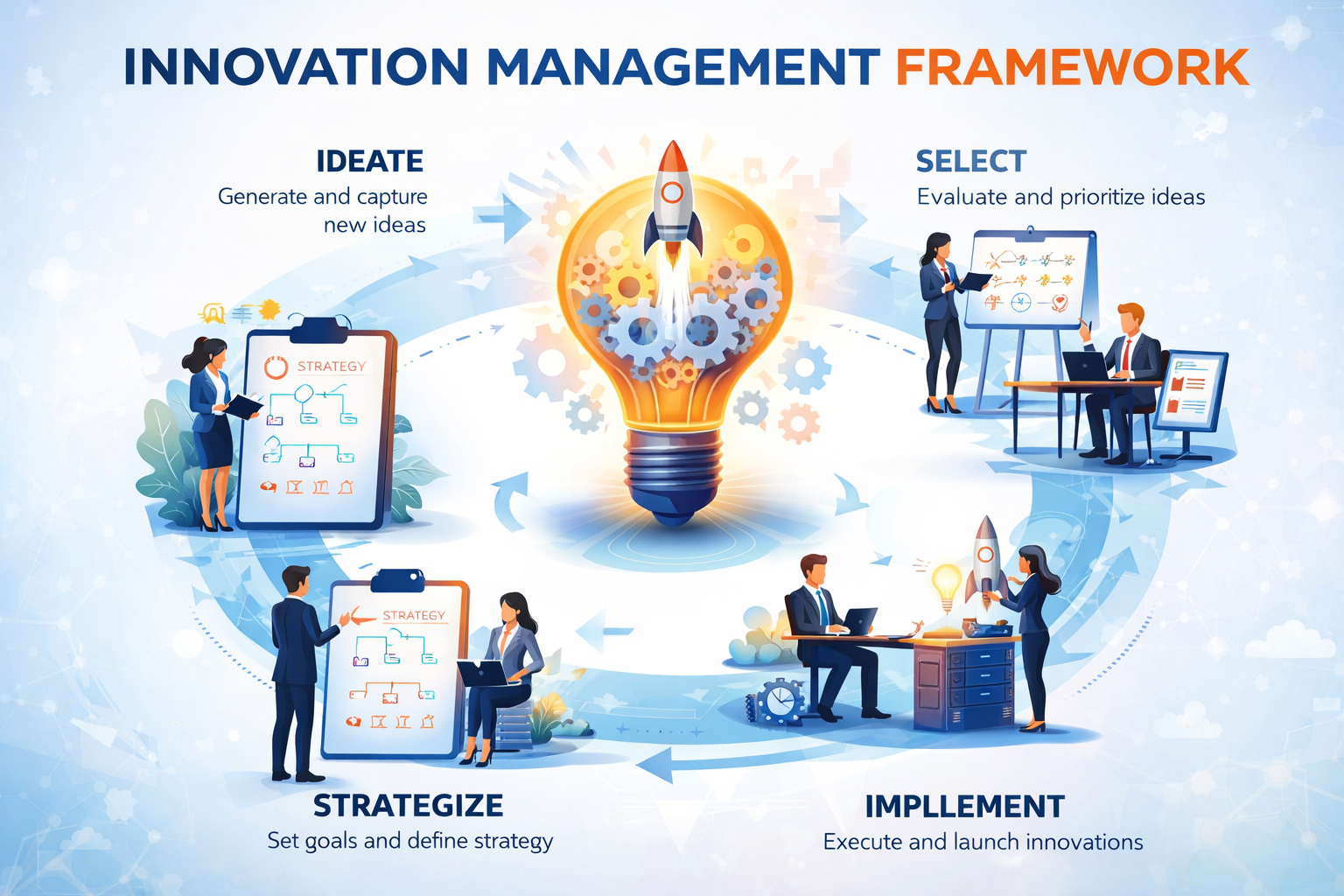
Decision gates are not standalone governance tools. They are most effective when they operate inside a connected innovation management framework where each stage answers a specific question and the gate between stages enforces the decision that connects one question to the next.
In the Traction Innovation Framework, decision gates are built into the workflow — not added on top of it. The platform captures the evidence required at each gate as a structured workflow output, tracks milestone progress and flags stalls before they become purgatory, and documents every gate decision with rationale that feeds the institutional memory of the program.
Download the Traction Innovation Framework guide →
Frequently Asked Questions
What is innovation theater?
Innovation theater is the state in which an organization is visibly active on innovation — running pilots, publishing trend reports, building dashboards — without producing the decisions that connect that activity to business outcomes. It is characterized by motion without resolution: initiatives that never formally conclude, pilots that technically succeed but go nowhere, and portfolios full of activity that leadership cannot connect to measurable impact.
What is a decision gate in innovation management?
A decision gate is a deliberate point in the innovation lifecycle where evidence is reviewed and a clear decision is made — advance, redirect, pause, or stop. It is not a checklist or a progress review. It is a commitment mechanism that ensures every pilot has a defined question, every completed pilot produces a decision, and every decision connects to a defined next step.
How many decision gates should an innovation program have?
Most programs benefit from three core gates: an early-stage gate before a pilot is approved, a pilot validation gate after a pilot is completed, and a scale-readiness gate before production deployment. The goal is not more gates but better-designed ones — fewer, more deliberate, with clear decision criteria and accountable owners.
Why do pilots stall even when they succeed technically?
Pilots stall after technical success when they were not designed to support a specific decision. A pilot that exists to "explore the space" produces learning but not direction. A pilot that exists to answer a specific question — should we proceed to scale? — produces evidence that supports a clear outcome. The design of the pilot determines whether success leads somewhere or dissipates into further exploration.
What is the difference between a decision gate and a stage gate?
Stage gates describe activity completion — whether required steps have been done. Decision gates describe commitment decisions — whether there is sufficient evidence to justify the next level of investment. Stage gates confirm effort. Decision gates produce direction. The distinction matters because programs built around stage gates produce documentation. Programs built around decision gates produce outcomes.
How does pilot purgatory happen?
Pilot purgatory happens when an initiative has no scheduled gate at which a scale or stop decision must be made. Without a structural forcing function, pilots extend indefinitely — consuming resources while stakeholders wait for someone else to declare a conclusion. The fix is not more urgency. It is a gate with a defined date, defined evidence requirements, and a defined decision owner.
Related Reading
- What Is an Innovation Management Framework? A Practical Guide for Enterprise Teams
- How to Design Innovation Decision Gates That Actually Work
- From Pilots to Performance: Why Innovation Needs an Operating Model
- Why Judgment Alone Doesn't Scale: The Case for Consistent Innovation Evaluation
- Why Pilot Management Software Is the Missing Link in Innovation Execution
- What Is Innovation Management? A Practical Definition for Enterprise Teams
About Traction Technology
Traction Technology is an AI-powered innovation management software platform trusted by Fortune 500 enterprise innovation teams. Built on Claude (Anthropic) and AWS Bedrock with a RAG architecture, Traction manages the full innovation lifecycle — from technology scouting and open innovation through idea management and pilot management — with AI-generated Trend Reports, AI Company Snapshots, automatic deduplication, and decision coaching built in.
Traction AI enables unlimited vendor discovery through conversational AI scouting — no boolean searches, no manual filtering, no analyst hours. With 50,000 curated Traction Matches plus full Crunchbase integration at no extra cost, zero setup fees, zero data migration charges, full API integrations, and deep configurability for each customer's unique workflows, Traction's innovation management platform gives enterprise innovation teams the intelligence and execution capability to turn innovation into measurable business outcomes. Recognized by Gartner. SOC 2 Type II certified.
Try Traction AI Free · Schedule a Demo · Start a Free Trial · tractiontechnology.com







.webp)